.jpg)
Climate change in Armenia and the Caucasus region is no longer a theoretical prediction, but a serious daily challenge. Statistics from recent years prove that our country’s temperature is continuously rising. Since 1935, 2024 was recorded as the 7th warmest year, and the winter of 2023–2024 was the second warmest in our history of observations. Nature’s anomalies do not end there: it was precisely the rise in average temperatures that led to the catastrophic floods in the Debed and Aghstev river basins.
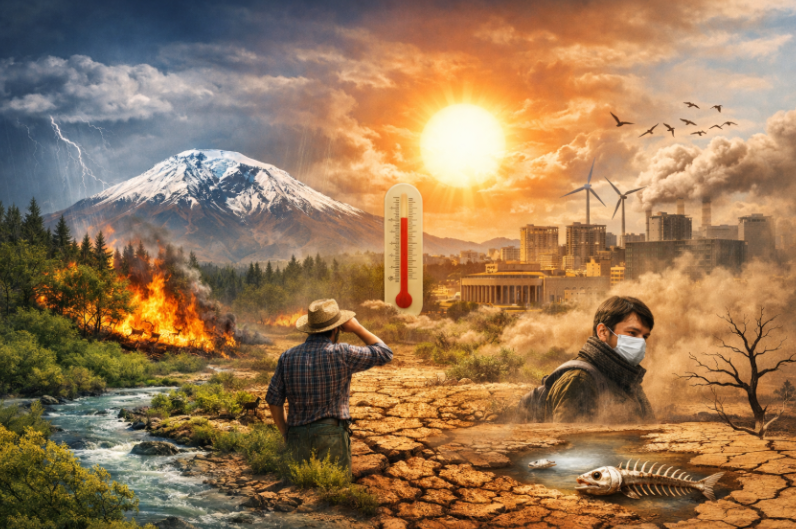
The rise in temperature brings a chain reaction, increasing evaporation and reducing river flow. The forecasts are concerning: by the year 2100, the annual flow of rivers feeding into Lake Sevan could decrease by about 34%. This is already forcing Armenia to seek alternatives, including taking additional water from the Araks River. However, water shortage primarily strikes agriculture. Without serious adaptation measures, crop yields could drop by 8–14% by 2030, and pastures could shrink by up to 22%.
The climate crisis also directly affects our health. High temperatures exacerbate cardiovascular diseases and create favorable conditions for the spread of new infections. Our ecosystems are also vulnerable; fires and pests destroy green spaces year after year. It is a painful fact: according to recent civil society monitoring, the difference in forest cover between 1993 and 2023 is approximately 45,000 hectares.
All of this carries a specific economic price. It is predicted that by 2060, the economy could suffer a 3% decline due to climate factors, leading to an increase in poverty of about 2.7% as early as 2030.
Today, climate change is not just an environmental topic; it is a matter of socio-economic survival. For Armenia, conservative water management, the introduction of new technologies in agriculture, and the strengthening of energy independence have become vital. Only through a coordinated adaptation policy will it be possible to ensure the country’s sustainable development and the well-being of our future generations.