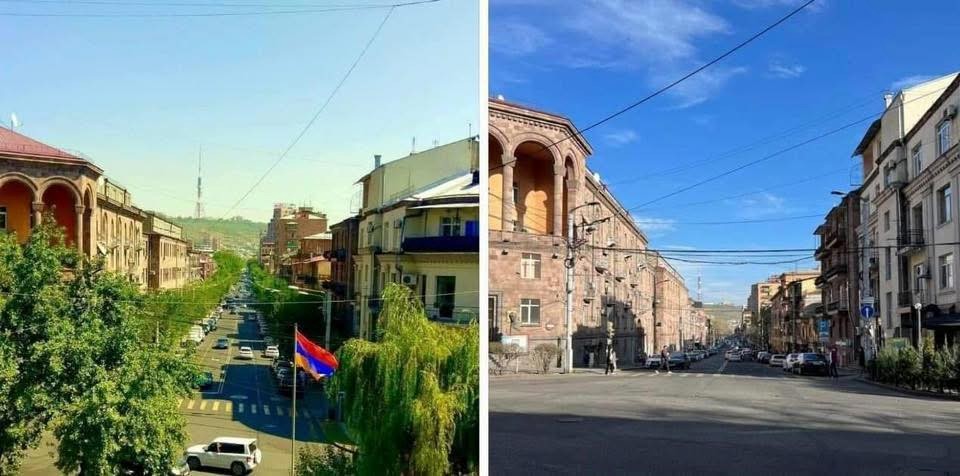
Concrete jungles, asphalted streets, and endless hustle—this is the daily life of a modern city dweller. However, within this gray monotony, green spaces have long ceased to be mere decorations. They are the city’s “lungs,” which today in Armenia are facing a severe trial.
For Armenia, this issue is more than urgent. According to recent statistics, public green space per capita in Yerevan is about 8.3 square meters, which still falls below the minimum threshold set by the WHO. Yet, a more alarming reality is hidden behind these figures: Yerevan today is suffocating in dust and pollution. Levels of suspended particulate matter in the air regularly exceed permissible norms, becoming a primary cause for the rise in serious illnesses—a situation fueled by the scarcity of green mass and ongoing deforestation.
In this crisis, the policy adopted by city authorities is a cause for serious concern. The intensive logging being carried out, justified as removing “aged” trees, often results in trees not being replaced at all or being replaced with “low-value” species. Environmentalists and botanists are sounding the alarm: instead of the mature trees being cut down, the wrong species are often chosen—ones that lack the resilience typical for these climatic conditions and, most importantly, lack the sufficient capacity to absorb dust and toxic substances. Furthermore, mature trees have formed complex ecosystems over decades, serving as vital habitats for numerous birds and insects whose loss disrupts urban biodiversity.
The decorative replacement trees, while perhaps beautiful from a landscape design perspective, often fail to compensate for the ecological services provided by decades-old plane or oak trees. Given Yerevan’s dry continental climate and high levels of air pollution, the city needs large-canopy, dust-absorbing tree species with optimal phytomeliorative properties capable of creating a real “protective shield” for the population.
Greenery should not be a mechanical update or a business project, but a clear strategy for ecological security. If the factors of urban air quality and climatic features continue to be ignored in the selection of tree species, then even increasing the acreage will not save Yerevan from an ecological disaster. The capital needs not “ornamental green,” but a healthy, functioning ecosystem that simply allows us to breathe.