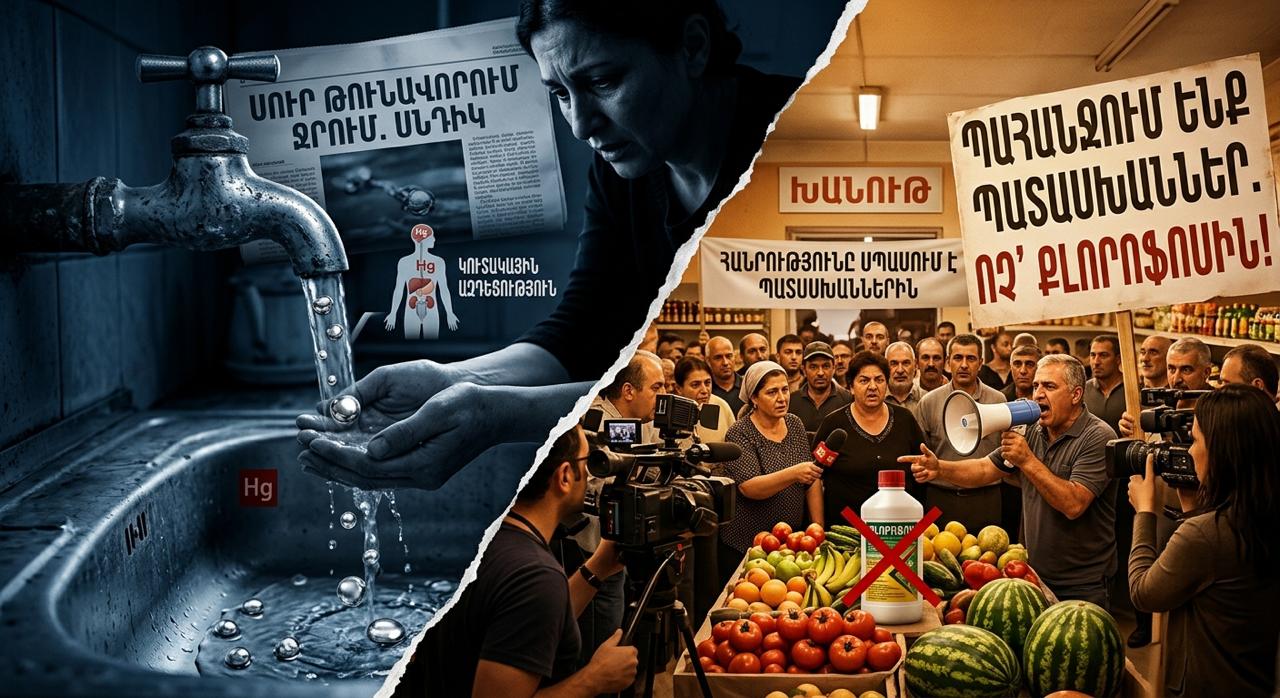
Mercury (Hg) belongs to the first hazard class of toxic substances, and its effects on the human body leave irreversible consequences. Entering the body through the respiratory tract or through drinking water, it causes chronic poisoning (mercurialism). Because of mercury's exceptional toxicity, the international community has adopted a policy of strictly limiting its use and circulation. The Republic of Armenia ratified the Minamata Convention on Mercury back in 2017, and adopted the RA Law “On Mercury” in 2022. This international instrument and the national legislation prohibit the illegal circulation, import, and export of mercury, its compounds, and mercury-containing products, as well as the uncontrolled release of their waste into the environment.
After mercury was detected in the water of the Tsav settlement in Syunik region, Health Minister Anahit Avanesyan rushed to reassure the public on Public Television, stating: "We have no victims. We did not wait for citizens to come to us — a field medical team has gone out, we are talking with residents on the ground, and we are listening to their complaints."
At first glance this may sound reassuring, but from a medical standpoint, the minister's claim reflects not only a degree of professional weakness but also a tendency to mislead the public.
Immediate, obvious symptoms (nausea, sharp pain, loss of consciousness, or sudden death) only appear when an extremely high concentration of mercury enters the body.
Mercury entering through drinking water does not produce immediately noticeable symptoms that a field medical team could detect through a quick on-site examination. As a first-class toxic substance, mercury has cumulative properties: it gradually builds up in the liver, kidneys, and brain, and chronic poisoning (mercurialism) progresses unnoticed. It destroys the nervous system, causing memory loss and other severe consequences that may only appear months or years later — by which point the damage is already irreversible.
Therefore, declaring "there are no victims" based merely on "listening to residents’ complaints," without in-depth, long-term toxicological research, is at the very least irresponsible. The state apparatus is attempting to mask the long-term, hidden danger of mercury with the superficial thesis that "there is currently no death or acute complaint."
Although environmental issues often receive little attention against the backdrop of immediate threats to human life and health, mercury's impact on ecosystems is no less devastating. Downplaying this ecological disaster is unacceptable — it directly threatens the mass poisoning of the population. Mercury that enters water basins is converted, through bacterial action within the aquatic environment itself, into the far more toxic methylmercury. It then penetrates soil, plants, and agricultural produce through irrigation use. Once it enters the food chain, the danger is no longer confined to the residents of Tsav alone: through the consumption of produce irrigated with that water, mercury — via the same cumulative mechanism — can poison the population of the entire region for years to come, undermining both human health and the region's ecological balance.
The appearance of a strategically significant toxic substance in the drinking water network is not an ordinary domestic or technical accident. This is directly a matter of state and national security. The water supply system is one of the country's core infrastructures, and its contamination — or a possible act of sabotage — demanded an immediate, transparent, and firm response from the state and law enforcement bodies.
However, more than 10 days have passed since the alarm was raised, but the public still has not received answers to the questions of how this dangerous substance entered the water supply system, whether an act of sabotage occurred or there was an illegal discharge of chemical waste, and what specific measures are being taken to guarantee the future safety of the water pipelines and water resources.
State Inaction and the "Correction" of the Topic with Chlorophos
Although the Tsav village case received significant public attention and raised serious concerns, the state apparatus and the responsible agencies did not take full responsibility. Instead of providing an adequate criminal-legal and security assessment, identifying those responsible, and providing the public with transparent information, an organized diversion of public attention took place.
Just a few days after the mercury uproar, a new, emotionally "explosive" topic was thrown into the information space: media outlets and videos began actively circulating claims that an employee at a fruit-and-vegetable store was allegedly spraying chlorophos on the produce.
The public, naturally, "took the bait." The serious topic of mercury threatening state security was immediately pushed to the background, and everyone began discussing the irresponsible behavior of an individual store and an individual person instead.
This is a textbook example of information manipulation.
- A systemic failure (contamination of the water supply network, a weakness in state security) is replaced by individual irresponsibility (the act of one shopkeeper or employee).
- The state’s inaction and negligence are overshadowed by a household-level scandal that is easy to "resolve" — by ostentatiously fining or closing down the store in question.
The presence of mercury in strategically significant water resources is a national tragedy that cannot be silenced or covered up with chlorophos "shows." As long as state authority responds to threats to public safety not with systemic solutions but with distracting informational manipulations, the security of the country and its population remains vulnerable.